

Early Mission Beach bathhouses rose on open sand in the 1910s


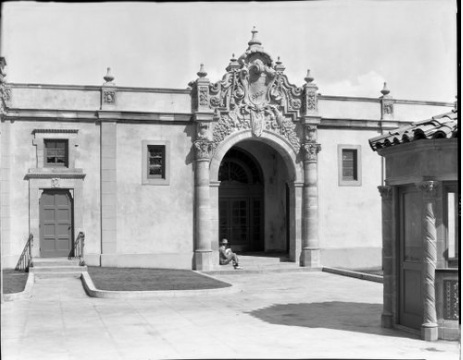
Many people are strolling or sitting in front of the building’s ornate facade. c. 1925. (Photo and caption info courtesy of the San Diego History Center)
At Mission Beach in the mid-1910s, entering the water meant stepping onto an undeveloped shoreline where bathhouses were only beginning to take shape.
In the mid-1910s, one such bathhouse stood under construction near what are today Queenstown Court and Redondo Court. Its wooden frame rises from open sand, exposed and unfinished, with the coastline stretching wide and unbroken behind it. There is no continuous beachfront development, no boardwalk, and no defined edge between town and sea — just sand, surf, and a structure still coming into being.

At this stage, Mission Beach is only beginning to take shape along the narrow strip between Mission Bay and the Pacific Ocean. A street grid has been laid out, but development remains uneven, with open lots and scattered construction marking the landscape. A few figures stand along the shore, set against a coastline that is still largely open and unformed.


Bathhouses in this period were simple shoreline buildings that supported early beachgoing. They provided changing space, basic shelter, and storage for personal belongings for visitors using the ocean. In many coastal communities, they were among the first permanent structures placed near the water.
Taking shape
Bathhouses reflected the practical rhythm of a day at the beach. Visitors arrived carrying clothing, towels, and supplies, then moved between sand and surf. The bathhouse offered a fixed point on an otherwise open shoreline — a place to pause, change, and return to the water without ever fully leaving the beach.
Rather than destinations, these structures organized movement. People gathered around them naturally, using them as anchors in an otherwise unmarked landscape.
Unlike later recreational developments, early bathhouses were tied directly to open-water swimming. The ocean itself was the attraction. Enclosed pools and amusement-style “plunges,” which would appear in Mission Beach in the 1920s, represented a later shift toward controlled swimming environments.
No bikinis here
Beachgoing at the time required preparation. Swimwear was often made of heavy wool fabrics, and a day at the coast meant planning for changing, storing belongings, and returning to the water throughout the day.
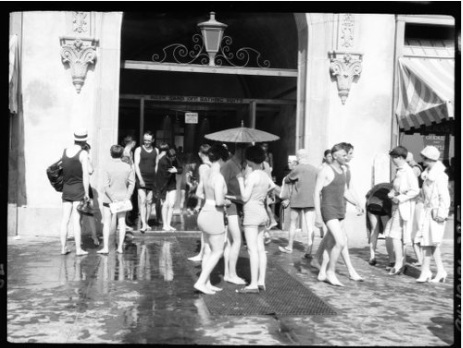
Just north along the shoreline, Pacific Beach had already developed early forms of beach recreation, including facilities tied to changing and ocean access during its resort-era growth.

Mission Beach would continue to evolve in the years that followed, as roads, buildings, and recreational spaces filled in the peninsula — transforming open sand into a structured seaside community.
Read more history stories here, and do you have a story to tell? Send an email to DebbieSklar@cox.net.
Sources:
San Diego History Center Digital Collections.
City of San Diego – Mission Bay Park history.
Mission Beach Women’s Club archives.
Pacific Beach Historical Society.
San Diego History Center archival materials.
Categories
Recent Posts


GET MORE INFORMATION